About Aerod
Practical browser, connection, and privacy research
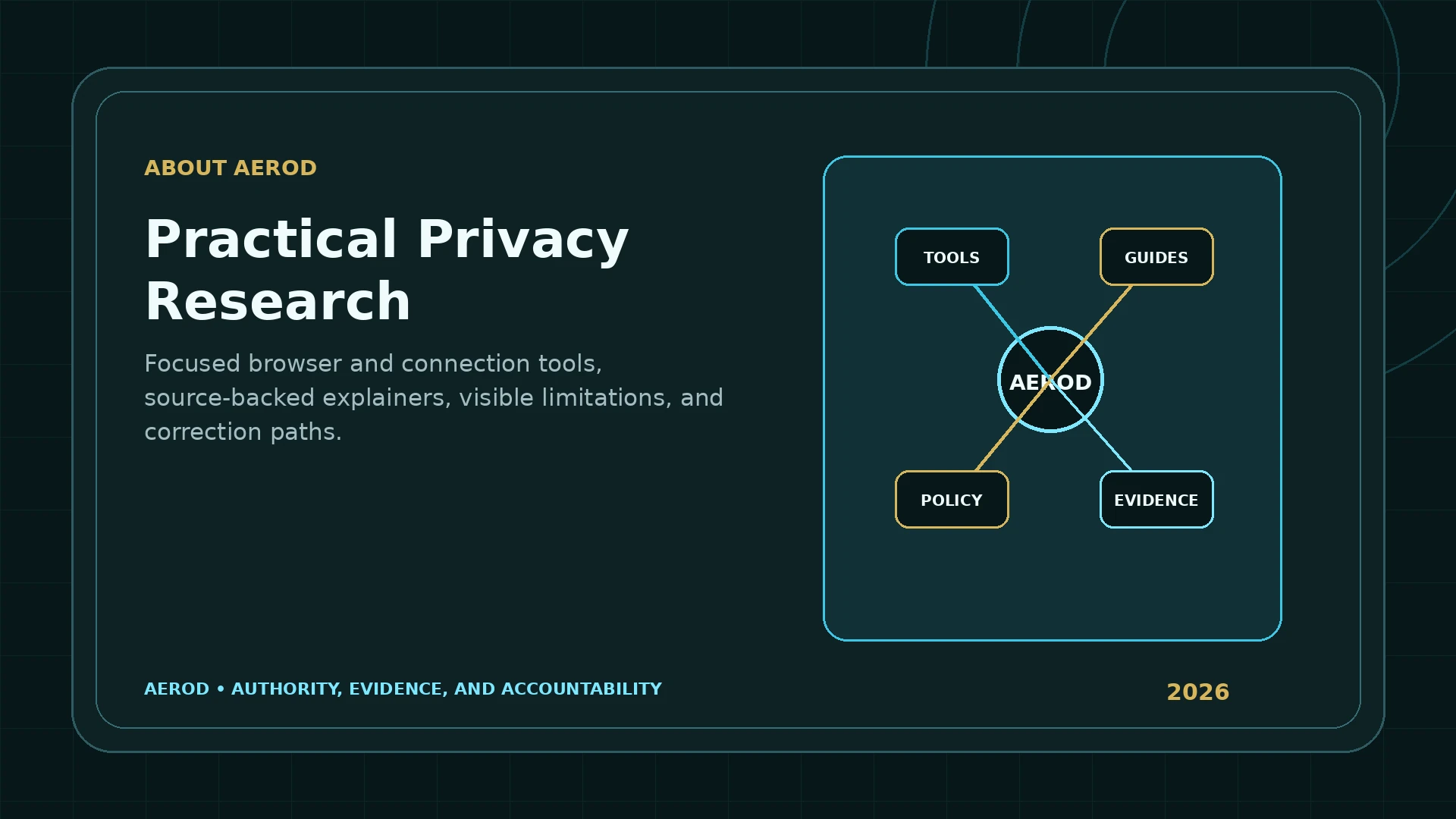
Aerod builds focused diagnostic tools and publishes source-backed explanations for IP visibility, WebRTC, browser exposure, fingerprinting, proxy and VPN routing, media-device access, and defensive security.
Mission
Explain what a result means without claiming more than it proves
Privacy and network tools often collapse several signals into one alarming or reassuring score. Aerod separates those signals. A public IP check, WebRTC candidate, browser fingerprint, permission state, DNS path, proxy rule, and camera preview answer different questions.
The goal is practical interpretation: what was checked, what the current session returned, why it matters, what the result cannot establish, and what should be reviewed next.
Focused tools
Each app is scoped to a specific browser, route, permission, or device question instead of pretending to certify anonymity or universal security.
Technical guidance
Guides connect browser and network behavior to concrete settings, diagnostics, standards, provider documentation, and explicit limitations.
Provider research
Proxy and VPN pages separate official provider claims, dated pricing, reported performance ranges, checks readers can run with Aerod tools, commercial relationships, and unresolved gaps.
Editor
Rowan Hale
Rowan Hale is the pen name of Aerod's editor. Rowan covers proxy and VPN services, network privacy and browser diagnostics, comparing published pricing and plan terms, provider documentation and reported performance, and checking routes with Aerod's own browser tools.
Rowan is a pen name. Aerod does not publish staff photos, and the byline does not claim credentials or hands-on provider testing. How Aerod reviews VPNs and proxies explains what each review weighs.
Organizational bylines
Aerod Security Lab
Aerod Security Lab is the collective byline for Aerod's browser tools, diagnostic guides and technical documentation. Aerod Editorial is the byline for policies and the review of published pages. Both are organizational bylines, not invented people.
Public editorial records identify the author, reviewer, publication date, review date, source count, and affiliate-disclosure state. Those records are available in the Evidence Register.
How Aerod works
Publication standards
Baselines, controlled variables, repeatability, result limits, and release quality gates.
EvidenceSource and Evidence PolicyPrimary sources, provider claims, independent observations, checked dates, inference, and conflicts.
Provider researchProvider Review MethodologyPricing normalization, route type, success, latency, throughput, policy, support, and disclosure criteria.
Tool scopeApp MethodologyWhat each active Aerod app observes and what one browser session cannot prove.
Commercial independence
Affiliate links do not control conclusions
Aerod can earn commissions from disclosed commercial links. Affiliate relationships do not change the source hierarchy, test result, correction standard, inclusion criteria, or conclusion. A relevant non-affiliate provider can still be included, and an affiliate provider can receive a limited or negative conclusion.
Read the Affiliate Disclosure for the complete policy.
Corrections
Material errors should be visible and reviewable
Browser behavior, provider products, pricing, standards, and policies change. Material corrections update the page date and may be documented in the article or changelog.
Read the Corrections Policy or contact Aerod.
Privacy and security
Data boundaries and responsible disclosure
Aerod documents what active tools process, which results stay in the browser, when external data sources are queried, and where optional analytics preferences apply. Security reports have a separate responsible-disclosure path.