Aerod’s evidence standard is designed to make a claim traceable. A reader should be able to determine whether a statement came from a technical standard, official product documentation, a provider claim, an independent observation, or an inference.
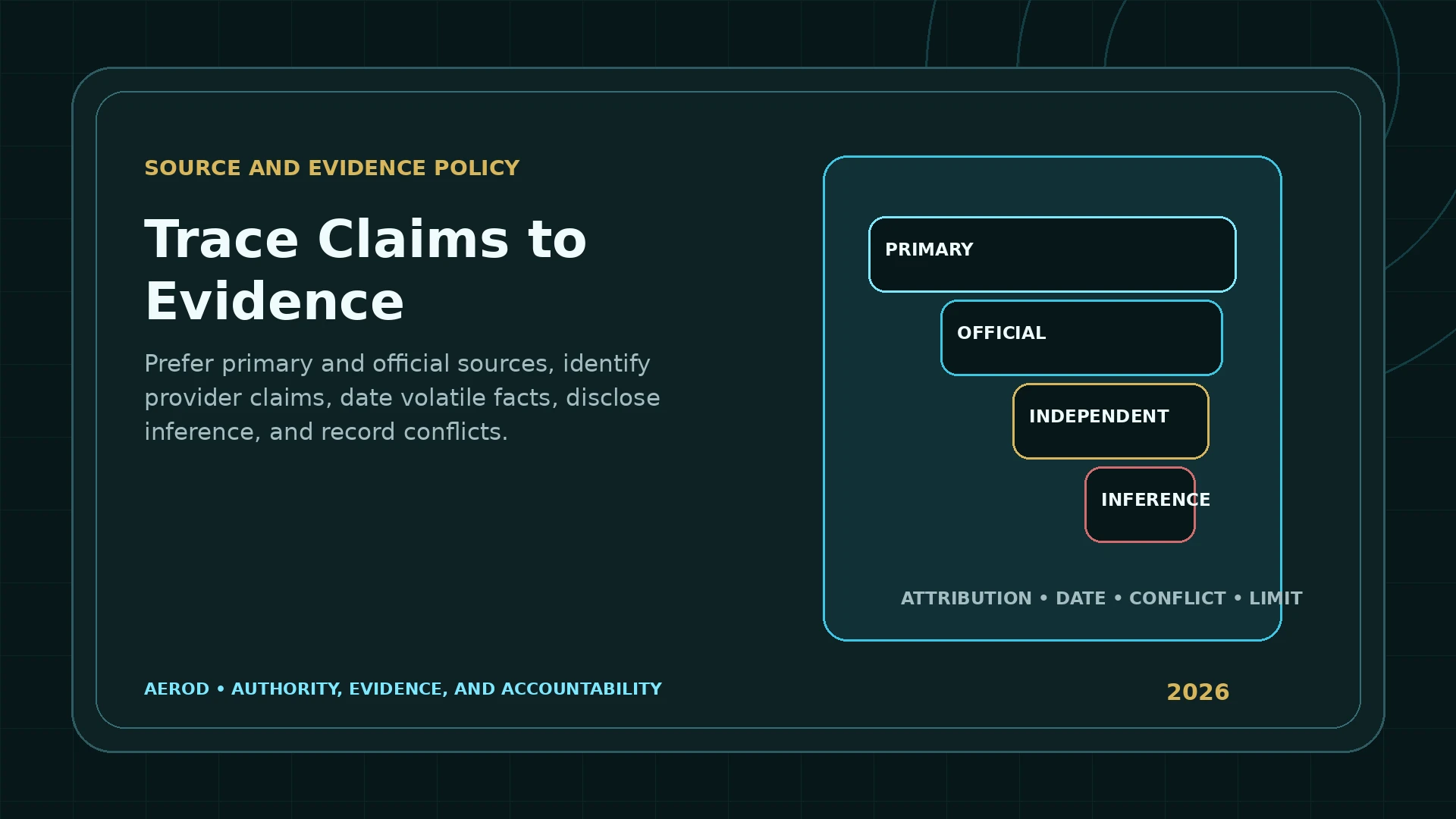
Evidence hierarchy
| Level | Examples | Best use |
|---|---|---|
| Primary standards and registries | RFCs, IANA registries, browser specifications, legal or regulatory text | Protocol behavior, address ranges, required terminology, and normative definitions |
| Official implementation documentation | Browser, operating-system, application, and vendor technical documentation | Current settings, supported features, error behavior, and product operation |
| Official provider material | Pricing, plan descriptions, policy pages, service status, network descriptions | What the provider currently claims or sells |
| Independent testing and observation | Documented measurements, screenshots, logs, controlled comparisons | Observed performance and behavior under stated conditions |
| Reputable secondary analysis | Specialist research and explanatory references | Context and synthesis when primary material is incomplete |
| Inference | A conclusion drawn from routing, ASN, timing, behavior, or indirect signals | Qualified interpretation when direct evidence is unavailable |
The hierarchy is not mechanical. A primary source can be old, irrelevant, or superseded. An independent test can be more useful than marketing for an observed-performance question. The page should explain why the chosen evidence fits the claim.
Attribution rules
Provider claims
Statements about pool size, location count, supported protocols, plan features, privacy practices, refund terms, pricing, or product limits should be attributed to the provider unless independently verified.
Preferred language includes “The provider lists,” “The current pricing page states,” “The documentation describes,” “Aerod observed,” and “The available evidence suggests.”
Avoid language that silently converts a provider statement into an Aerod measurement.
Observed results
An observed result should identify enough of the test context to be meaningful. Depending on the claim, include plan, route type, region, target, sample size, time window, browser or app, protocol, concurrency, and relevant limitations.
Inference
An inference should identify the observations, the reasoning connecting them, plausible alternatives, and the remaining uncertainty. It must remain visibly different from measurement.
Freshness and checked dates
| Information type | Freshness concern |
|---|---|
| Protocol definition | Usually stable unless superseded |
| Browser permission interface | Can change with browser releases |
| Provider pricing and plan limits | Can change without notice |
| Commercial destination | Can redirect, expire, or change terms |
| Performance result | Specific to time, route, plan, target, and load |
| IP geolocation | Can change as databases and assignments update |
Volatile facts should carry an accessed or checked date. A page’s review date should advance when a material claim is refreshed.
Source selection
- Relevant: directly supports the claim.
- Authoritative: close to the underlying standard, implementation, or observation.
- Current enough: age is appropriate for the fact.
- Accessible: readers can inspect it when possible.
- Specific: supports the exact value or behavior, not merely the topic.
A source list is not decoration. A long list of unrelated links does not improve evidence quality.
Conflicting evidence
- Confirm that sources describe the same product, version, region, plan, or protocol.
- Check each source’s publication and revision dates.
- Prefer direct standards or implementation evidence for technical behavior.
- Present both positions when the disagreement remains material.
- Explain which source Aerod relies on and why.
- Avoid false precision.
Pricing and commercial facts
Pricing pages should identify currency, billing term, minimum purchase, included traffic or endpoints, overage or renewal implications, checked date, and whether a displayed discount is temporary. “From” prices should not be compared as if they describe equivalent packages.
Images and generated diagrams
- A screenshot should retain enough context to identify what it shows.
- A generated diagram should explain a concept and must not be presented as a captured test result.
- A provider logo or product image should not imply endorsement.
- Alt text should describe the useful content.
- Material screenshots should be refreshed when the interface or claim changes.
Affiliate independence
Affiliate links can support Aerod, but the commercial relationship does not change the evidence hierarchy. A provider should not receive a stronger conclusion because it pays a commission, and a non-affiliate provider should not be excluded when it is relevant.
Commercial relationships are disclosed under the Affiliate Disclosure. Provider update requests are evaluated against evidence rather than accepted automatically.
AI-assisted research and drafting
AI assistance can help organize research, compare documents, and draft language. It is not treated as a source. Claims still need supporting evidence, attribution, review, and correction paths.
- Check for invented values or sources.
- Check for outdated product information.
- Separate similarly named plans and protocols.
- Remove unsupported certainty.
- Attribute provider claims.
- Remove generic filler that obscures the answer.
Source-link and archival practice
A source URL should lead as closely as possible to the supporting material rather than to a generic homepage. When official documentation has stable section links, Aerod should cite the relevant section. When a provider page is dynamic, the checked date and the exact product or plan should be recorded so a later reviewer can distinguish a genuine change from an earlier mistake.
Archived copies can help establish what a page said at a prior date, but an archive is not automatically the current source of truth. Archived material should be labelled as historical and should not override a newer official policy or product page without explanation. When a source requires an account or is no longer publicly accessible, the article should say that the evidence cannot be independently opened by every reader.
Quantitative claims
Numbers require the same context as prose claims. A benchmark value should identify the unit, sample size, aggregation method, target, environment, and test window. A percentage without a denominator or a speed without a baseline can be technically accurate but editorially misleading.
Use ranges or qualified language when precision exceeds the evidence. Do not average incompatible plan types, regions, protocols, or workloads into one number. When a provider publishes a quantitative claim that Aerod has not tested, attribute it and avoid adding a false implication of independent confirmation.
Source ownership and conflicts of interest
A source can be authoritative about its own product while still having a commercial interest. Provider documentation is appropriate for current features, pricing, and stated policy; it is not independent evidence that the product is the best, fastest, safest, or most private option. Independent sources can also have sponsorships, affiliate relationships, limited samples, or outdated data.
Aerod should consider who produced the evidence, what they could observe, what they benefit from, and whether another source can corroborate the material claim. Disclosure does not make biased evidence useless, but it changes how heavily the conclusion should rely on it.
Evidence metadata
Public editorial records carry author, reviewer, publication date, review date, sources, and affiliate-disclosure status. The Evidence Register publishes a compact index of those fields.
The register does not independently validate every claim. It makes the publication record easier to audit.
Corrections and unavailable sources
If a source disappears, look for the current official replacement, confirm whether the claim remains supportable, remove or qualify unsupported material, update the review date, and use a correction note or changelog entry when the meaning changes materially.
Correction requests can be submitted through Contact Aerod and are handled under the Corrections Policy.
FAQ
What sources does Aerod prefer?
Aerod prefers primary standards, official technical documentation, provider product and policy pages for provider-specific claims, and attributable independent testing for comparative observations.
Can provider marketing claims be used?
Yes, when they are clearly attributed to the provider and not presented as independently verified facts. Volatile claims should carry a checked date.
How does Aerod handle conflicting sources?
The disagreement should be stated, the more authoritative or current source should be identified, and the page should avoid presenting one disputed value as certain without explanation.
What happens when a value is inferred?
The page must label the value as an inference, identify the observations supporting it, and distinguish it from a direct measurement or official statement.
Do affiliate relationships change the evidence standard?
No. Affiliate relationships must be disclosed and cannot lower the sourcing, attribution, testing, correction, or uncertainty standard.