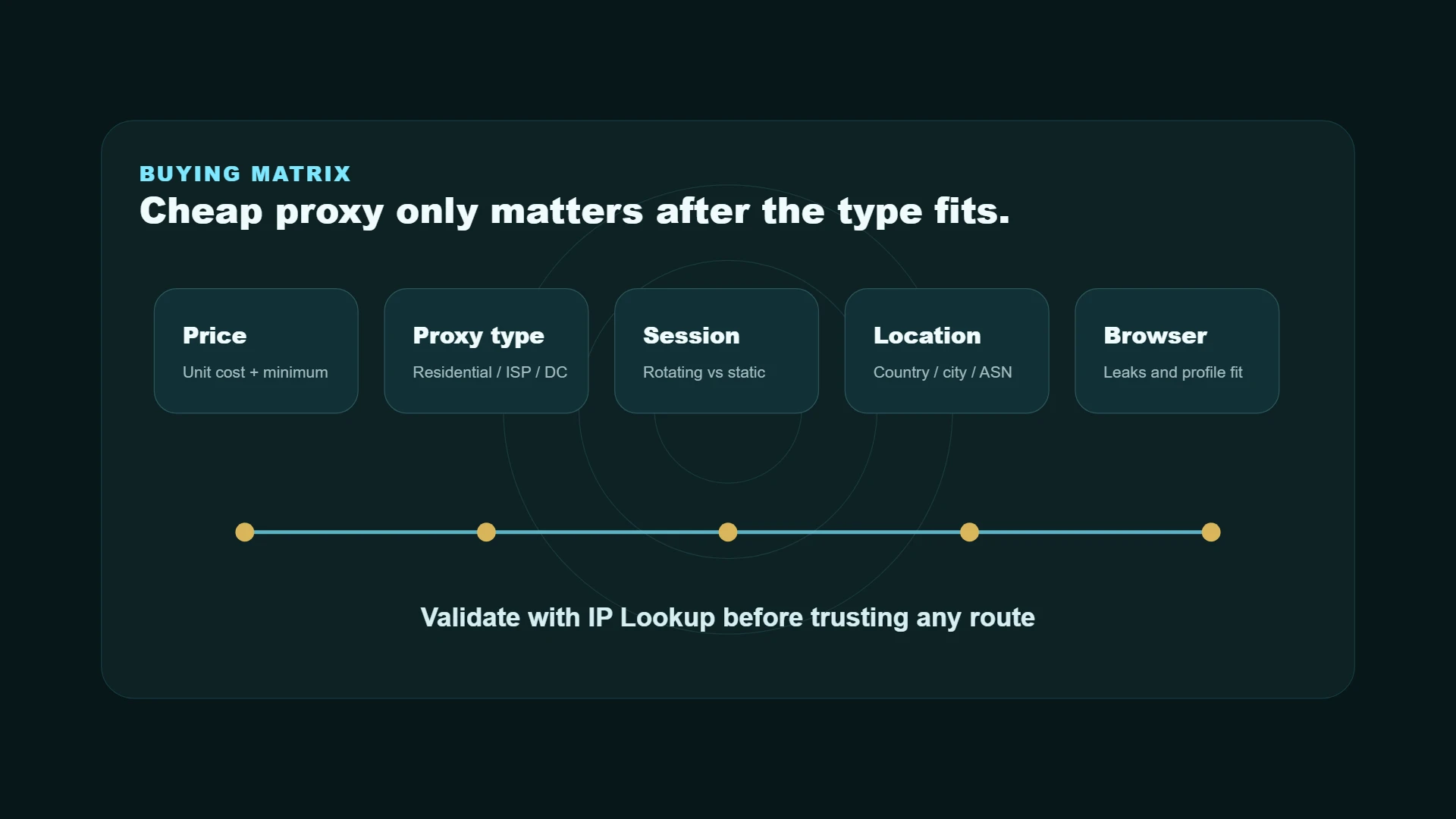
A cheap proxy is not simply the plan with the smallest number on the checkout page. It is the lowest-cost route that provides the right proxy class, session model, location, protocol, authentication, bandwidth, and minimum commitment for the job.
Use this broad shortlist to compare affordable proxy providers across product types. First choose the route you need, then use the dedicated guides for residential bandwidth costs, static ISP pricing, or datacenter bundles. The pricing explainer covers minimum purchases, expiry, and effective cost.
This guide compares ten lower-cost providers using public prices checked on September 2, 2026. This is a dated price snapshot, not a current quote or a permanent ranking. Promotions, minimums, renewal terms, targeting fees, and product availability can change.
Quick answer
The best low-cost provider depends on what “cheap” must include.
- Small non-expiring residential purchase: DataImpulse offers new users 5 GB for $5; its standard Basic purchase is $50 for 50 GB.
- Flat residential rate with non-expiring balance: PacketStream charges $1/GB with a $50 minimum.
- Free datacenter-style setup test: Webshare includes 10 proxy-server IPs free.
- Low-cost static ISP entry: Webshare, MarsProxies, IPRoyal, and Proxy-Cheap use different per-IP plans.
- Broader product catalog: IPRoyal, MarsProxies, Decodo, and SOAX cover several proxy classes.
- Shared datacenter bundle: ProxyScrape lists 1,000 shared proxies with 250 GB for $25/month.
Affordable proxy providers at a glance
| Provider | Best low-cost use | Public price signal checked | Main tradeoff |
|---|---|---|---|
| DataImpulse paid linkPaid link. Aerod may earn a commission if you purchase or sign up through this DataImpulse link. | Small pay-as-you-go residential purchase | $5 for 5 GB for new users; Basic $50 for 50 GB; traffic does not expire | Advanced city, state, ZIP, or ASN targeting can add cost. |
| PacketStream paid linkPaid link. Aerod may earn a commission if you purchase or sign up through this PacketStream link. | Simple non-expiring residential bandwidth | $1/GB; $50 minimum; no subscription | The minimum purchase is high for a one-off 1–10 GB test. |
| Webshare paid linkPaid link. Aerod may earn a commission if you purchase or sign up through this Webshare link. | Free proxy-server testing and low-cost static or rotating plans | 10 proxy-server IPs free; 100 for $2.99/month; rotating residential from $3.50/GB monthly | Its product types use different billing and should not be treated as equivalent. |
| Proxy-Cheap paid linkPaid link. Aerod may earn a commission if you purchase or sign up through this Proxy-Cheap link. | Promotional rotating residential or single static ISP tests | Static residential 7-day test $1.99; one month $2.71; rotating promotions displayed from $0.78–$1.50/GB | Promotional rates and plan sizes must be checked carefully. |
| Proxy-Seller paid linkPaid link. Aerod may earn a commission if you purchase or sign up through this Proxy-Seller link. | Granular static and rotating catalog choices | Residential plans displayed from $3.50 for 1 GB, falling with volume; static IPv4 prices vary by location and quantity | A broad catalog makes it easy to compare the wrong products. |
| MarsProxies paid linkPaid link. Aerod may earn a commission if you purchase or sign up through this MarsProxies link. | Residential, ISP, datacenter, and mobile under one account | Residential $4.99/GB at 1 GB and $2.99/GB at 100 GB; ISP from $1.35/IP; datacenter advertised from $0.99/IP | Each product has a different billing unit and commitment. |
| IPRoyal paid linkPaid link. Aerod may earn a commission if you purchase or sign up through this IPRoyal link. | Broad proxy-class flexibility and non-expiring residential traffic | 1 GB subscription $7/GB; pay as you go $7.35/GB; $1.75/GB subscription floor requires 10,000 GB | Small residential purchases are expensive relative to several alternatives. |
| ProxyScrape paid linkPaid link. Aerod may earn a commission if you purchase or sign up through this ProxyScrape link. | Shared datacenter proxy bundle | 1,000 shared proxies with 250 GB for $25/month | Shared datacenter IPs are not a substitute for residential or ISP reputation. |
| Decodo paid linkPaid link. Aerod may earn a commission if you purchase or sign up through this Decodo link. | Feature-rich residential plans with low self-service minimums | 3 GB at $3.75/GB; 10 GB at $3.50/GB; pay as you go $4/GB | More features and targeting can cost more than bare-bones bandwidth. |
| SOAX paid linkPaid link. Aerod may earn a commission if you purchase or sign up through this SOAX link. | Country-tiered credits for residential and mobile traffic | Sandbox: no plan fee, paid traffic; Builder: $200/month + VAT with 200 credits | No free traffic is included in Sandbox; country tier and plan determine the usage rate. |
How Aerod evaluates affordability
Methodology
Price is evaluated after product fit.
- Choose residential, ISP/static residential, datacenter, or mobile before comparing providers.
- Identify the billing unit: per GB, per IP, per day, or bundled monthly plan.
- Include the minimum purchase, renewal, traffic expiry, bandwidth limits, and targeting fees.
- Check protocol, authentication, rotation, sticky-session, and location controls.
- Separate provider-stated features and prices from independent test results.
- Validate the route in the actual client and permitted target before scaling.
What “cheap” costs in real examples
| Scenario | Low headline option | Real commitment | Why another option may still fit better |
|---|---|---|---|
| 5 GB residential test (new-user Intro) | DataImpulse: $5 at $1/GB | $5 | A provider with stronger targeting or target-specific performance may justify a higher rate. |
| 10 GB residential use | PacketStream: $10 of usage | $50 minimum purchase, but the balance does not expire | Webshare’s 10 GB monthly plan costs $27.50 with a lower upfront payment than PacketStream. |
| Free client configuration test | Webshare: 10 proxy-server IPs free | No proxy purchase | A free datacenter route cannot predict paid residential or ISP behavior. |
| 100 shared datacenter proxies | Webshare: $2.99/month | Monthly subscription | Dedicated or cleaner datacenter IPs can cost more but offer different control. |
| 1,000 shared datacenter proxies | ProxyScrape: $25/month | Monthly bundle | Shared pool quality, location stock, and target acceptance still need testing. |
| 100 GB of Tier 1 residential/mobile traffic | SOAX Builder: $3/GB for Tier 1 | $300 + VAT: $200 plan credits plus $100 extra credits | Sandbox has no monthly fee but charges $5/GB for Tier 1: $500 for this example. |
Best cheap residential proxy options
DataImpulse: small non-expiring introductory purchase
DataImpulse paid linkPaid link. Aerod may earn a commission if you purchase or sign up through this DataImpulse link. lists a new-user $5 purchase for 5 GB (Basic is $50 for 50 GB), no residential traffic expiry, free country targeting, HTTP(S) and SOCKS5, rotating or sticky sessions, and IP authorization. The introductory offer is a low-commitment way to try a permitted public-data or regional-testing task; it is not the standard refill minimum.
Watch: advanced state, city, ZIP, or ASN targeting can add cost, and the provider’s own performance claims should not be treated as independent measurements.
PacketStream: simple $1/GB with a larger minimum
PacketStream paid linkPaid link. Aerod may earn a commission if you purchase or sign up through this PacketStream link. charges $1/GB with no recurring subscription and a non-expiring balance. It supports rotating or sticky sessions, recommends HTTPS, and also exposes SOCKS5 and HTTP. The tradeoff is a $50 minimum purchase.
Watch: the rate is simple, but a user needing only a few gigabytes must still fund the $50 minimum.
Webshare: lower monthly residential entry
Webshare paid linkPaid link. Aerod may earn a commission if you purchase or sign up through this Webshare link. listed 1 GB rotating residential at $3.50/GB monthly and 10 GB at $2.75/GB. Its endpoint generator supports country or city selection, rotating or sticky sessions, and several authentication methods.
Watch: the displayed prices include discounts and subscription conditions. Read the full Webshare review.
Proxy-Cheap: aggressive promotional rates
Proxy-Cheap paid linkPaid link. Aerod may earn a commission if you purchase or sign up through this Proxy-Cheap link. displayed rotating-residential promotions at $1.50/GB for 3 GB+, $1.20/GB for 4 GB+, and $0.78/GB for 51 GB+. At the listed thresholds, those rates imply $4.50, $4.80, and $39.78 before any checkout adjustments.
Watch: treat them as dated promotional price signals, not permanent prices. Confirm the final plan, session controls, targeting, refund conditions, and renewal.
Decodo: higher price with broader controls
Decodo paid linkPaid link. Aerod may earn a commission if you purchase or sign up through this Decodo link. listed 3 GB at $3.75/GB, 10 GB at $3.50/GB, and pay as you go at $4/GB. Plans include broad geo-targeting, HTTP(S) and SOCKS5, and rotating or sticky sessions.
Watch: this is not the lowest raw bandwidth price. The value comes from the platform, targeting, and integration depth.
Best cheap ISP and static residential options
Webshare static residential
Webshare listed 20 or 100 static residential IPs at $0.30 per IP per month. The low unit price is attractive, but buyers should verify location stock, fair-use behavior, authentication, protocol, and the exact route classification.
MarsProxies ISP
MarsProxies paid linkPaid link. Aerod may earn a commission if you purchase or sign up through this MarsProxies link. advertised an ISP floor of $1.35 per proxy. Its detailed selector displayed $2.99 for one IP before term or quantity discounts. Confirm the selected duration and total; the headline floor is not a one-IP monthly quote.
IPRoyal ISP
IPRoyal paid linkPaid link. Aerod may earn a commission if you purchase or sign up through this IPRoyal link. documents dedicated ISP IPv4 routes, HTTP/HTTPS and SOCKS5, username/password or IP whitelisting, and country, state, or city targeting. Public starting prices should be checked against the specific location and quantity.
Read the full IPRoyal review and IPRoyal vs Webshare comparison.
Proxy-Cheap static residential
Proxy-Cheap listed a seven-day static residential test at $1.99 and a one-month Basic plan at $2.71 per proxy. This can be useful when the user needs one stable route rather than a rotating pool.
Best cheap datacenter options
Webshare proxy server
Webshare includes 10 proxy-server IPs free and listed 100 IPs for $2.99/month. This is the lowest-friction setup test in the group.
ProxyScrape shared datacenter
ProxyScrape paid linkPaid link. Aerod may earn a commission if you purchase or sign up through this ProxyScrape link. listed 1,000 shared HTTP/SOCKS proxies with 250 GB for $25/month, before VAT, for all locations on the 30-day subscription selector. The selected 250 GB allowance is not the separate unlimited-bandwidth option.
Proxy-Seller static IPv4
Proxy-Seller paid linkPaid link. Aerod may earn a commission if you purchase or sign up through this Proxy-Seller link. exposes location- and quantity-dependent static IPv4 pricing. The provider’s current price table showed US IPv4 rates around $0.90 per IP for five and lower unit prices at large quantities.
Watch: location, rental period, dedicated/shared status, protocol, and quantity affect the result. Use the Proxy Type Selector before buying from a broad catalog.
MarsProxies datacenter
MarsProxies advertises dedicated datacenter proxies from $0.99 per proxy, with HTTP/HTTPS/SOCKS5 and unlimited bandwidth under the product’s terms. The detailed selector displayed $1.99 for one IP; the lower headline rate depends on the purchase configuration.
Best broader budget platforms
IPRoyal
IPRoyal is not the cheapest 1 GB residential purchase, but it covers residential, ISP, datacenter, and mobile products, and residential traffic does not expire. This makes it useful for intermittent or changing requirements.
MarsProxies
MarsProxies covers residential, ISP, datacenter, and mobile. Its detailed residential table ranged from $4.99/GB at 1 GB to $2.99/GB at 100 GB and $1.65/GB at 10,000 GB, while ISP and datacenter products use per-IP pricing.
Decodo
Decodo is a step up when targeting, integrations, API access, or multiple proxy classes matter more than the lowest unit price.
SOAX
SOAX paid linkPaid link. Aerod may earn a commission if you purchase or sign up through this SOAX link. now prices residential and mobile traffic with country-tiered credits. Sandbox has no monthly plan fee or included credits and charges $5, $3.75, or $2 per GB for country Tiers 1, 2, or 3. Builder costs $200/month + VAT with 200 credits ($1 each), and usage rates of $3, $2.25, or $1.20 per GB. Monthly-plan credits roll over for 60 days.
Watch: “Sandbox Free” refers to the plan fee, not free bandwidth. Price the target country and expected usage before choosing a subscription.
How external test data changes the decision
Low price does not prove connection reliability, speed, or IP quality. Proxyway’s 2026 residential benchmark illustrates the tradeoff: Webshare produced 99.28% global infrastructure success and a 0.86-second average response time, while IPRoyal produced 96.11% and 1.24 seconds. IPRoyal, however, had the cleaner global detectability result at 16.70% compared with Webshare’s 33.61%.
Those are Proxyway measurements collected primarily in March and April 2026, not Aerod measurements. They do not predict every target, plan, or location. The correct process is to use public benchmarks to narrow the shortlist, then run a target-specific sample.
Which proxy type should you buy?
- Shared datacenter: lowest cost when datacenter classification is acceptable.
- Dedicated datacenter: more control and continuity, usually at a higher per-IP price.
- Rotating residential: bandwidth-based consumer-network routes for permitted collection or regional testing.
- Static ISP / residential: one stable ISP-classified route for longer sessions.
- Mobile: only when the workflow specifically needs a carrier-network route.
Use the Proxy Type Selector before comparing provider brands. Also read Free vs Paid Proxies when deciding whether a free allocation is enough.
Affordable proxy buying checklist
Before purchase
- Define the permitted use case and target.
- Choose the proxy class before the provider.
- Calculate minimum purchase and real monthly commitment.
- Check whether traffic expires.
- Check monthly, yearly, renewal, and promotional terms.
- Confirm HTTP(S), SOCKS5, or client-specific support.
- Confirm username/password and IP-allowlist options.
- Confirm rotating, sticky, or static session behavior.
- Check location and targeting availability.
- Review refund, trial, fair-use, and acceptable-use terms.
- Test the exact route with IP Lookup.
- Review DNS, WebRTC, timezone, language, and browser profile consistency.
FAQ
What is the cheapest proxy provider?
There is no single cheapest provider for every job. DataImpulse and PacketStream advertise $1 per GB residential traffic, Webshare offers 10 proxy-server IPs free and 100 for $2.99 per month, while Proxy-Cheap and MarsProxies publish low-cost static options. The cheapest usable choice depends on proxy type, minimum purchase, bandwidth, rotation, and location.
What is the cheapest type of proxy?
Shared datacenter proxies are usually the least expensive per IP. They are also easier for websites to classify as hosting-provider traffic. Residential and ISP proxies cost more because they provide different route reputation and session characteristics.
Are affordable proxies safe?
They can be appropriate for lawful workflows when the provider, product, and route are verified. Low price does not make a proxy private or trustworthy by itself, and the browser can still reveal WebRTC, timezone, storage, fingerprinting, and account-state signals.
Should I buy residential or datacenter proxies?
Choose datacenter proxies when low cost, throughput, and stable infrastructure matter and the target accepts datacenter networks. Choose residential proxies when consumer-network routing is relevant. Choose static ISP proxies when one stable ISP-classified route is more important than rotation.
Is a free proxy enough to test a setup?
A reputable free allocation can confirm credentials, protocol support, routing, and client compatibility. It cannot prove that a paid residential, ISP, mobile, or larger pool will behave the same way on the final target.
Should I test a proxy after buying it?
Yes. Test the exact route from the browser or application that will use it. Check the visible IP, ASN, owner, approximate location, DNS path, WebRTC candidates, timezone, language, and session behavior before adding a real account.
Sources and checked dates
- IPRoyal residential pricing — checked September 2, 2026.
- Proxy-Seller pricing — checked September 2, 2026.
- Proxy-Cheap static residential pricing — checked September 2, 2026.
- Proxy-Cheap rotating residential pricing — checked September 2, 2026.
- Webshare pricing — checked September 2, 2026.
- DataImpulse residential pricing — checked September 2, 2026.
- PacketStream pricing — checked September 2, 2026.
- MarsProxies pricing — checked September 2, 2026.
- ProxyScrape pricing — checked September 2, 2026.
- Decodo residential pricing — checked September 2, 2026.
- SOAX pricing — checked September 2, 2026.
- Proxyway Proxy Market Research 2026 — published June 30, 2026; most data collected March–April 2026.
- Proxy-Seller residential plans — checked September 2, 2026.
- MarsProxies residential pricing — checked September 2, 2026.
- MarsProxies ISP pricing — checked September 2, 2026.
- MarsProxies datacenter pricing — checked September 2, 2026.