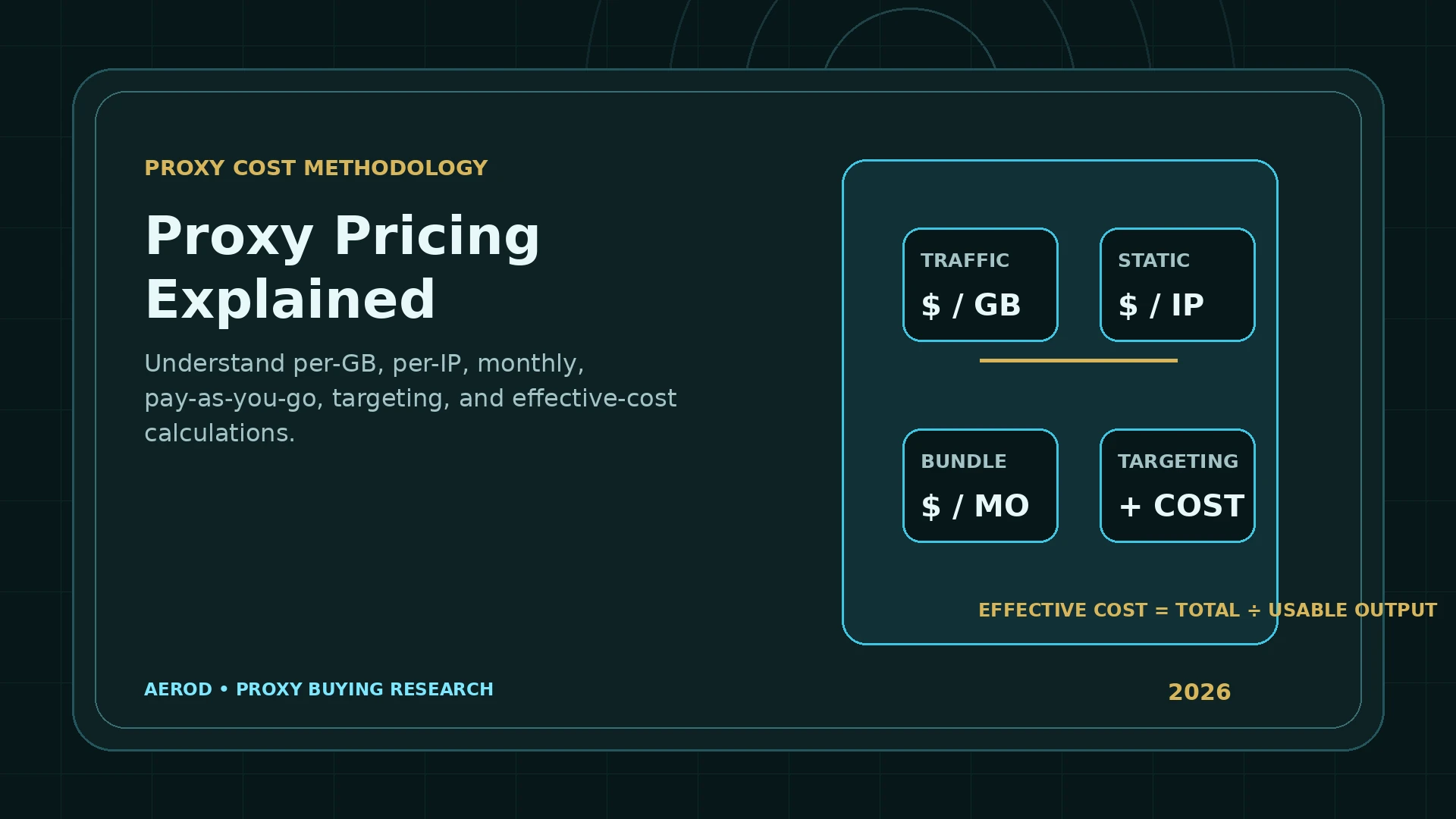
Proxy pricing is difficult to compare because providers sell different products with different billing units. A residential gateway priced per gigabyte, a static ISP address priced per month, and a shared datacenter bundle priced by pool size are not substitutes.
This is the calculation guide, not a provider ranking. Once you know the billing model, compare residential, ISP, or datacenter costs. The IPRoyal vs Webshare comparison shows why purchase size and expiry can change a head-to-head decision.
Provider price examples were rechecked September 2, 2026 in USD. Taxes, eligibility, selected options, and renewal terms can change the checkout total. Usage-efficiency calculations below are illustrative, not measured results.
Core rule
Compare the same proxy type, quantity, location, session model, and time period.
The cheapest plan is the one with the lowest cost per useful result—not necessarily the lowest number printed beside “per GB” or “per IP.”
The main proxy pricing models
| Model | Common products | Best for | Main hidden cost |
|---|---|---|---|
| Per GB | Residential, mobile, rotating datacenter | Variable or short projects | Retries, page size, targeting, and unused subscription traffic |
| Per IP | ISP/static residential, dedicated datacenter | Stable, recurring sessions | Minimum quantity, rental term, and unusable IPs |
| Monthly bundle | Shared datacenter pools, platform plans | Predictable recurring usage | Unused capacity and auto-renewal |
| Pay as you go | Residential, mobile, rotating gateways | Irregular usage | Higher unit rate at low volume |
| Unlimited or unmetered | Dedicated datacenter/ISP or high-volume residential | Traffic-heavy workloads | Fair-use, concurrency, speed, or target restrictions |
| Per port or gateway | Backconnect and reseller products | Teams managing many sessions through one endpoint | Port count, concurrency, and rotation controls |
Per-GB pricing
Per-GB plans meter traffic transferred through the proxy. Providers can count request and response bytes, so a page with large images, video, fonts, or repeated retries costs more than a small API response.
Worked example: small PAYG purchase
DataImpulse paid linkPaid link. Aerod may earn a commission if you purchase or sign up through this DataImpulse link. offers new users 5 GB of residential traffic for $5; its Basic purchase is $50 for 50 GB. A qualifying introductory 5 GB project therefore starts at $5. If only 3 GB produces useful results and 2 GB is consumed by retries or unnecessary assets, the effective cost is:
$5 ÷ 3 usable GB = $1.67 per usable GB.
Worked example: subscription utilization
Webshare paid linkPaid link. Aerod may earn a commission if you purchase or sign up through this Webshare link. currently displays 10 GB at $27.50, or $2.75/GB. If the subscriber uses only 4 GB before renewal:
$27.50 ÷ 4 used GB = $6.88 per used GB.
Worked example: larger minimum with non-expiring balance
PacketStream paid linkPaid link. Aerod may earn a commission if you purchase or sign up through this PacketStream link. charges $1/GB but requires a $50 purchase. A user who needs 5 GB still funds $50. The unused balance does not expire, so the economic question is whether the remaining 45 GB will be useful later.
Per-IP pricing
Per-IP plans charge for a fixed number of endpoints over a term. This model is common for ISP and dedicated datacenter proxies. It can be economical for high bandwidth because traffic is often unmetered, but the buyer carries route-quality and inventory risk.
Worked example: static ISP tier
Webshare lists 250 static residential IPs at $0.30 each per month:
250 × $0.30 = $75/month.
If only 200 routes meet the location and target requirements, the effective cost becomes:
$75 ÷ 200 usable IPs = $0.375 per usable IP-month.
Worked example: longer dedicated term
IPRoyal paid linkPaid link. Aerod may earn a commission if you purchase or sign up through this IPRoyal link. shows a 30-day private-proxy card from $1.57/IP and a 90-day card from $1.39/IP. These are advertised starting figures, not a verified one-IP checkout total. Do not assume the longer-term card is the entire bill or multiply it without confirming how the checkout labels the unit. For an explicit monthly-equivalent quote, multiply the monthly amount by the number of months and IPs.
Monthly platform plans
A platform plan can include more than proxy bandwidth: multiple proxy types, targeting, API access, support, dashboards, and data-extraction tools. The correct comparison is not only cost per GB; it is whether those features reduce engineering and operating cost.
SOAX paid linkPaid link. Aerod may earn a commission if you purchase or sign up through this SOAX link. now offers a no-plan-fee Sandbox with paid traffic and a $200/month + VAT Builder plan containing 200 credits ($1 each). For 100 GB in a Tier 1 country, Builder consumes $300: $200 in plan credits plus $100 extra. Sandbox charges $5/GB for the same tier, or $500. Rates differ by country tier; unused monthly-plan credits roll over for 60 days. “Free” describes the Sandbox plan fee, not its bandwidth.
Unlimited and unmetered pricing
“Unlimited bandwidth” means the provider does not bill by traffic under the stated plan. It does not remove every limit. Review:
- Port speed.
- Concurrent connections.
- Connection rate.
- Target or domain restrictions.
- Fair-use policy.
- Rental duration.
- Acceptable-use rules.
ProxyScrape’s shared datacenter plan, for example, lists 1,000 proxies and 250 GB for $25/month, while its unlimited-residential product uses a different flat-rate product and pool. Compare the exact product rather than treating every “unlimited” label as equivalent.
Targeting and feature surcharges
Advanced targeting can increase the rate or reduce available inventory. Potential cost drivers include:
- State, city, ZIP, ASN, or ISP targeting.
- Longer sticky sessions.
- Dedicated or exclusive IPs.
- Mobile carrier or OS filters.
- Higher concurrency.
- Sub-user management.
- Premium or filtered pools.
A provider can have the lowest base rate but a higher final rate after the required targeting and product options are selected.
Traffic expiry and renewal
| Plan behavior | Benefit | Risk |
|---|---|---|
| Traffic does not expire | Good for intermittent use | Balance is still wasted if the provider or route type does not fit |
| Monthly traffic resets | Predictable recurring allocation | Unused traffic is lost at renewal |
| Auto-renewing per-IP plan | Keeps stable routes assigned | Renewal continues until cancelled |
| Fixed term | Can lower the unit rate | Locks the buyer into the route inventory and provider |
Taxes, currency, and checkout totals
Public tables may exclude VAT, sales tax, payment fees, or currency conversion. A price shown in dollars can be billed in another currency or include tax only at checkout. Store the final invoice total when comparing providers.
How to calculate effective proxy cost
Effective cost per usable gigabyte
Total plan cost ÷ gigabytes that produced usable output.
Effective cost per accepted request
Total plan cost ÷ successful target requests.
Effective cost per usable IP
Total plan cost ÷ IPs that passed location, ASN, reputation, and target checks.
Effective cost per completed record
Proxy cost + retries + engineering time ÷ valid records delivered.
The last formula is usually the most useful for a real data workflow. A higher proxy rate can be cheaper when it reduces retries, engineering effort, and unusable output.
Pricing decision table
| Workload | Usually compare first | Reason |
|---|---|---|
| One-time 5 GB regional test | Low-minimum PAYG residential | A monthly commitment may waste budget |
| Stable long browser session | Per-IP ISP proxy | Continuity matters more than pool size |
| High-bandwidth target that accepts hosting ASNs | Dedicated datacenter per IP | Unmetered traffic can be cheaper |
| Small client setup test | Free shared datacenter tier | Validates authentication and integration at no purchase cost |
| Large variable collection | Volume residential plan | Per-GB rates fall with commitment |
| Multi-product team | Platform bundle | Central controls may reduce operating cost |
Before buying
Record the full price—not only the advertised unit
- Proxy type.
- Billing unit.
- Minimum purchase or plan size.
- Traffic expiry or renewal date.
- Location and targeting fees.
- Protocol and authentication.
- Rotation and sticky-session controls.
- Bandwidth and concurrency limits.
- Tax and payment total.
- Measured usable output from a small test.
Use the Affordable Proxy Providers guide for a buying shortlist, then compare residential, ISP, and datacenter pricing within the correct product class.
FAQ
What does per-GB proxy pricing mean?
The provider charges for traffic transferred through the proxy gateway. The price can include both request and response data, so page size, retries, and unnecessary assets affect the bill.
What does per-IP proxy pricing mean?
The provider charges for a fixed number of proxy IPs over a rental period. This model is common for dedicated datacenter and ISP proxies and can include unlimited bandwidth under plan terms.
How do I calculate the effective cost of a proxy plan?
Divide the total plan cost by the useful output: usable gigabytes, accepted requests, stable IPs, completed records, or successful test sessions. Headline unit price alone does not show effective cost.
Does non-expiring traffic make a plan cheaper?
It can when usage is intermittent because unused balance remains available. It does not help when the provider lacks the targeting, session behavior, or target-specific performance the workflow needs.
Are unlimited proxy plans really unlimited?
Unlimited usually means no per-GB charge. Providers can still impose speed, concurrency, port, fair-use, target, and acceptable-use restrictions.
Should I choose the cheapest provider or the cheapest proxy type?
Choose the cheapest proxy type that fits the target and session first. Then compare providers within that product class using the same quantity, location, protocol, and billing period.