You can build a paid web-scraping service without being a professional programmer, but the product is not “a scraper.” The product is a reliable answer to a business question: a cleaned spreadsheet, a recurring price monitor, a change alert, a market report, or a dataset that saves someone hours of manual research.
An LLM can help write Python, explain errors, and break the project into steps. You still need to choose a lawful public-data target, understand the output, test the result, respect access controls and site rules, and deliver data a buyer can trust.
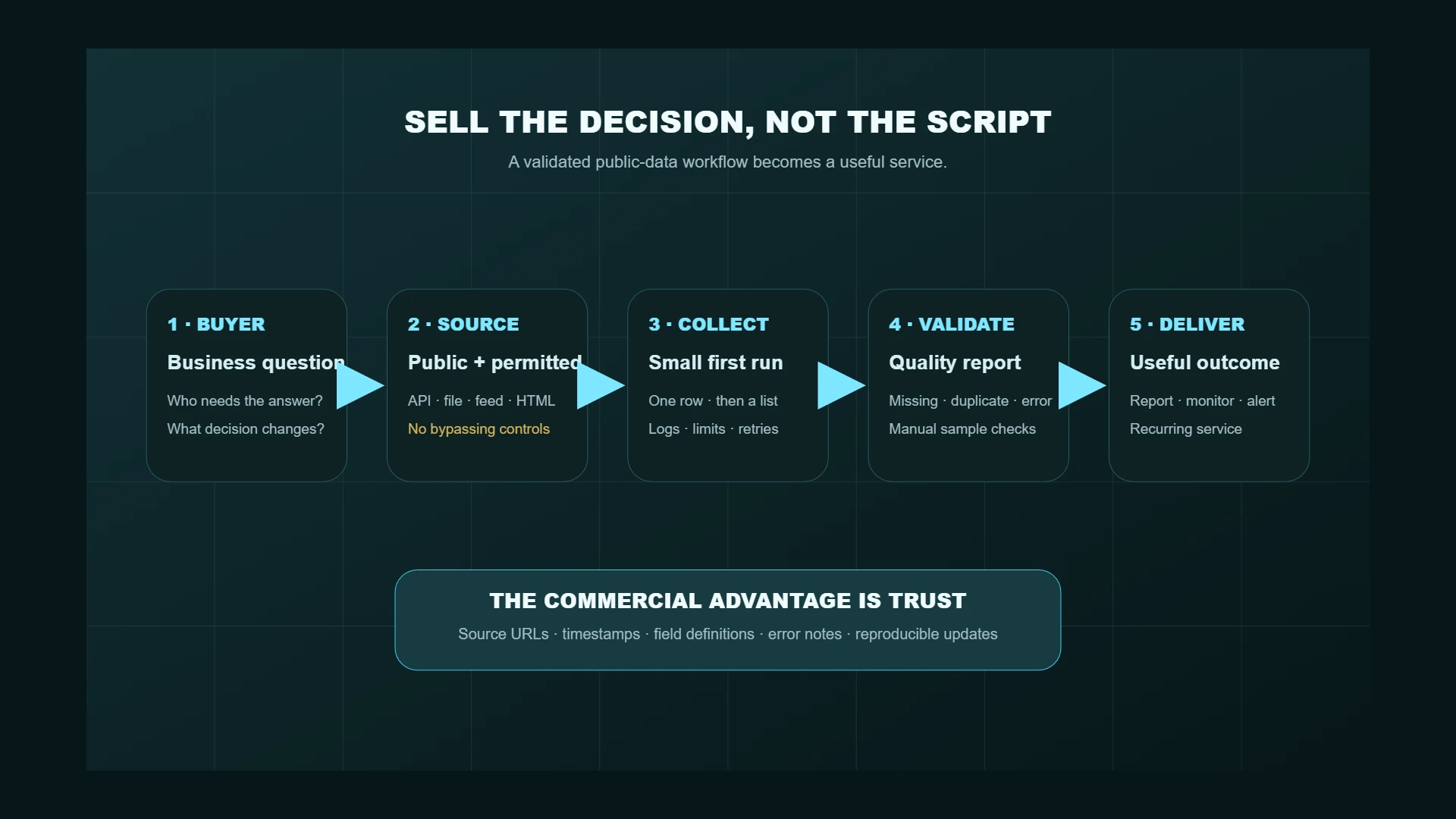
Sell outcomes, not scripts
Most clients do not care whether the collection layer uses requests, Beautiful Soup, Playwright, a public API, an RSS feed, or a spreadsheet import. They care about accuracy, freshness, coverage, structure, and whether the result helps them decide something.
| Offer | Example deliverable | Why a buyer may pay |
|---|---|---|
| One-time research file | Public competitor products, prices, stock status, source URLs, and collection date | Replaces hours of manual research |
| Recurring monitor | Weekly changes in price, inventory, fees, job openings, or feature pages | Shows changes while there is still time to act |
| Normalized catalog | Supplier records standardized into SKU, price, stock, shipping, and minimum order | Makes inconsistent pages usable in operations |
| Market report | Public listings summarized by area, category, availability, or trend | Turns raw rows into an executive-ready view |
| Alert service | Email or dashboard alerts when a field changes | Reduces the need to check pages manually |
| Internal decision tool | A lightweight search, filter, or comparison interface over collected data | Makes the dataset useful to a team repeatedly |
A one-time CSV is easy to start. A recurring monitor is usually more defensible because the buyer needs the result again.
Start with the buyer and the decision
A useful scraping idea normally has three traits:
- The information changes often enough to matter.
- It is painful to collect manually.
- A buyer can make or save money from a better view of it.
| Niche | Public data | Possible buyer | Practical offer |
|---|---|---|---|
| Ecommerce | Product title, price, stock, promo badge, shipping threshold | Store owner, brand, reseller, agency | Daily competitor monitor |
| Local services | Service menu, price, area served, availability | Local operator, franchise, marketing agency | Monthly competitor report |
| Recruiting | Job title, location, skills, salary range, remote status | Staffing firm, training company, career service | Skills-demand dashboard |
| B2B software | Pricing, integrations, release notes, feature pages | SaaS founder, product marketer, analyst | Competitor change digest |
| Events | Dates, venues, speakers, sponsors, ticket tiers | Agency, local publication, event operator | Event intelligence database |
| Public real estate listings | Price, status, amenities, date listed, area | Property analyst, relocation service, investor | Weekly listing trend report |
Start with one sentence: “This data helps this buyer make this decision.” If that sentence is weak, a bigger scraper will not fix the business model.
What not to scrape
Avoid targets that depend on bypassing controls or collecting sensitive data:
- private or login-gated accounts without permission
- personal contact data harvested from profiles
- medical, financial, identity, or other sensitive personal information
- copyrighted articles repackaged as a substitute for the original
- paywalled content
- data behind CAPTCHAs, access controls, or anti-bot systems you intend to defeat
- sites whose terms clearly prohibit the intended use
- workflows that create excessive load or disrupt the service
Robots.txt is one part of responsible crawling, not a grant of permission. RFC 9309 standardizes the Robots Exclusion Protocol as a way for service owners to control crawler access. Google's documentation likewise explains that robots.txt controls which paths crawlers may access. Neither source turns robots.txt into the entire legal analysis.
Use the simplest data source first
Before automating a browser, look for a cleaner source:
- Public API
- Downloadable CSV or spreadsheet
- RSS or Atom feed
- Sitemap or structured data
- Server-rendered HTML
- JavaScript-rendered page
- Browser interaction only when necessary and permitted
The simpler source is usually faster, cheaper, easier to validate, and less likely to break.
A beginner-friendly Python stack
| Job | Tool | Use it when |
|---|---|---|
| Download a normal HTML page | requests |
The data is present in the server response |
| Parse HTML or XML | Beautiful Soup | You need cards, links, tables, text, or attributes |
| Interact with a browser | Playwright for Python | The permitted page requires JavaScript, clicking, or pagination |
| Clean and export data | pandas | You need CSV/Excel, deduplication, joins, filters, or summaries |
| Store a small recurring dataset | SQLite | One local database file is enough |
| Store multi-user or larger history | PostgreSQL | The service needs a durable database and concurrent access |
Playwright's Python documentation covers browser automation and supported browser engines. pandas I/O documentation covers import and export formats. Beautiful Soup documentation explains HTML/XML parsing.
A practical ChatGPT workflow
Do not start with “scrape this website.” Give the model the decision, output schema, boundaries, and test plan.
Step 1: Define the exact output
Example:
Build a Python tool that collects public product pages from an approved list of outdoor brands. Save brand, source URL, product title, listed price, stock status, category, and collection time to CSV. Do not log in, bypass controls, or collect personal data.
Step 2: Inspect the source manually
Confirm:
- whether the data is public
- whether a public API, feed, CSV, sitemap, or structured-data block already exists
- whether content is server-rendered or requires JavaScript
- how pagination works
- which fields are consistently available
- what the site terms and robots.txt say
- an appropriate request rate and schedule
Step 3: Ask for a plan before code
Ask ChatGPT to list:
- the safest collection method
- libraries
- file structure
- output schema
- validation rules
- likely failure modes
- logging approach
- what you must verify manually
Step 4: Build the smallest working version
Use this order:
- collect one permitted page
- extract one record
- save one row
- validate the row manually
- process a small URL list
- add pagination if needed
- add deduplication
- add retries with limits
- add logging
- add a validation summary
Step 5: Make the code explain itself
Ask the model to explain each function in plain English, identify assumptions, and show where selectors or field mappings may fail. A non-coder still needs to recognize what the script is doing before selling the output.
Step 6: Add tests and guardrails
Useful requirements include:
- stop when the page structure changes unexpectedly
- record HTTP errors and skipped URLs
- limit retries
- add polite delays
- avoid duplicate rows
- validate required fields
- include source URL and collection time
- write a summary of missing fields and errors
Methodology
AI-assisted scraper build order
- Define a lawful public-data target and the buyer decision first.
- Use an API, feed, file, or static HTML before browser automation.
- Build and verify one record before scaling the URL list.
- Add validation, logs, and duplicate handling before scheduling.
- Review every AI-generated selector, request, and data transformation.
- Deliver source URLs, collection dates, error notes, and field definitions with the data.
Five realistic starter projects
1. Competitor price and stock tracker
Collect public product pages for a narrow category. Deliver the latest price, availability, promotion, source URL, and timestamp. Add a change report in later runs.
2. Local service comparison
Collect public price menus, services, service areas, booking availability, or trial offers for one city and industry. Sell the cleaned report to operators or agencies in that niche.
3. Job-skill demand report
Collect public job listings from allowed sources and summarize repeated skills, location patterns, salary ranges, and remote status. Avoid personal applicant data.
4. SaaS competitor change log
Monitor public pricing, feature, integration, and changelog pages. Deliver a weekly digest of additions, removals, and wording changes.
5. Supplier catalog monitor
Collect public SKU, price, stock, minimum order, and shipping fields. Normalize inconsistent labels and flag missing values.
Store the data for the product you are selling
| Situation | Storage choice | Why |
|---|---|---|
| One-time delivery | CSV or Excel | Easy for clients to review and import |
| Repeat collection on one computer | SQLite | Keeps history without running a server |
| Multi-user service or larger history | PostgreSQL | Better concurrency, permissions, and growth path |
| Analysis notebook | Parquet plus pandas | Efficient for repeated analytical work |
| Client dashboard | Database plus a small web app | Supports filters, history, and user access |
Do not overwrite history if the value comes from change detection. Keep a stable record key, source URL, collection timestamp, and the fields that changed.
Turn rows into something worth buying
One-time research spreadsheet
Deliver a cleaned workbook with a data tab, field definitions, source URLs, and validation notes. Add a short summary of patterns and gaps.
Recurring monitor
Refresh the same sources on a schedule and send a report of added, removed, and changed records. This is often easier to sell as a monthly service than a one-time scraper.
Alert system
Notify the client only when a threshold or field changes: price below a target, item back in stock, new job matching a skill, new location added, or competitor plan changed.
Niche report
Summarize the dataset into trends, counts, exceptions, and practical interpretation. Do not copy source prose; use factual fields to support original analysis.
Internal decision tool
Put the cleaned data behind a search/filter interface for one team. The software is only useful if the data remains current and explainable.
Find clients without selling “scraping” as a commodity
Freelance marketplaces
Pitch the outcome in the client's language: competitor monitoring, price tracking, catalog normalization, public-market research, or weekly change reports. A clear scope beats “I can scrape any website.”
Direct outreach
Choose a niche, build a small sample from permitted public sources, and send it to businesses that already make the decision the data supports. Explain what was collected, when, from where, and what the sample reveals.
Productized reports
Publish or privately sell a repeatable niche report. Keep source rights, licensing, privacy, freshness, and redistribution limits in mind. A custom service is usually simpler than trying to launch a general data marketplace product on day one.
Where dataset marketplaces fit
Cloud data marketplaces can distribute licensed datasets to established buyers, but they are not the easiest beginner path. Marketplace providers usually need clear rights to distribute the data, stable schemas, documentation, refresh schedules, support, and quality controls. A collection of public facts is not automatically yours to resell without restriction.
Start with custom research or a recurring report for one client. Consider a marketplace only after you can document provenance, permitted use, licensing, update frequency, privacy review, and the commercial value of the dataset. Official provider documentation for AWS Data Exchange and Snowflake Marketplace illustrates the operational expectations of formal data distribution.
Use scraped public data for your own decisions
A dataset can be valuable even when you never sell the rows directly:
- Ecommerce research: compare public prices, stock, shipping thresholds, and product changes before deciding what to source or promote.
- Better client proposals: use public competitor and market data to support an original recommendation instead of a generic pitch.
- Career planning: summarize public job requirements, salary ranges, location patterns, and repeated skills without collecting applicant information.
- Content and newsletter research: monitor public release notes, events, pricing changes, and source metadata, then write original analysis rather than republishing source content.
- Supplier monitoring: track public stock, minimum order, and shipping changes to support procurement decisions.
The same quality rules apply: retain source URLs, timestamps, field definitions, and a clear distinction between source facts and your interpretation.
Proxies, VPNs, and browser profiles
Do not begin with proxies. Begin with a small, polite, permitted collection job. A proxy becomes relevant when the allowed workflow genuinely requires regional testing, application routing, or distributed public-data collection.
| Tool | Useful for | Does not do |
|---|---|---|
| Proxy | Route a specific browser, script, or application through another IP | Make prohibited scraping allowed or invisible |
| VPN | Device-wide encrypted route and public-Wi-Fi protection | Manage many independent browser identities |
| Proxifier | Route an app that lacks native proxy settings | Fix a browser fingerprint or data-quality problem |
| Separate browser profile | Isolate cookies, storage, and extensions | Change every device-level signal |
| Aerod IP Lookup | Verify the visible public route and ASN | Prove the whole workflow is private or compliant |
Use the proxy type selector before choosing a provider. Use the Proxifier setup guide and Proxifier rule examples for application routing. Verify the active route with IP Lookup and use Proxy/VPN Detection when route context and browser signals disagree.
A realistic 30-day plan
| Week | Goal | Deliverable |
|---|---|---|
| 1 | Choose one buyer, one decision, and one permitted source set | One-page offer and ten possible clients |
| 2 | Build a small AI-assisted Python collector | A manually verified 50-row sample |
| 3 | Package the result | Data tab, validation tab, field dictionary, and short findings summary |
| 4 | Sell a paid pilot | Targeted outreach, calls, feedback, and one defined pilot scope |
A strong first offer is specific:
I will build a one-time competitor pricing file for up to 75 public pages, including source URLs, collection date, price, availability, missing-field notes, and a short summary.
A recurring version adds weekly refreshes and change detection.
Quality control separates a service from a data dump
Every delivery should include:
- source URLs
- collection timestamp
- field definitions
- missing-field count
- duplicate count
- error and skipped-page log
- a sample of manually checked rows
- notes about changed page structures
- clear limits on coverage
Web scraping delivery checklist
- Confirm the source is public and the intended use is allowed.
- Record source URLs and collection timestamps for every row.
- Limit request rate and stop on repeated errors or blocks.
- Validate a sample manually before delivering the dataset.
- Include missing-field, duplicate, and skipped-page counts.
- Separate factual source fields from your own analysis.
- Explain update frequency, coverage limits, and what can break.
Common mistakes
| Mistake | Why it fails | Better approach |
|---|---|---|
| Building before choosing a buyer | Produces data nobody needs | Start with a decision and buyer |
| Selling raw rows only | Raw data is easy to compare on price | Add cleaning, validation, history, and interpretation |
| Scraping too much too soon | Breakage and errors become difficult to diagnose | Start with 50–200 verified rows |
| Trusting generated code blindly | Selectors and assumptions can be wrong | Build in stages and inspect every function |
| Ignoring access rules | Creates avoidable legal and operational risk | Review terms, robots.txt, permissions, and request volume |
| No storage model | History disappears and duplicates accumulate | Choose CSV, SQLite, or PostgreSQL intentionally |
| No validation report | The client cannot assess quality | Deliver data and QC together |
| Competing as a generic scraper | Creates a race to the bottom | Specialize in one buyer and recurring outcome |
FAQ
Can you make money web scraping without knowing how to code?
Yes, if “without knowing code” means you are learning enough to define, test, and operate the workflow while ChatGPT assists with implementation. You still need to understand the data schema, errors, source rules, and quality checks.
Is Python the best place to start?
For most beginners, yes. Python has mature libraries for HTTP requests, HTML parsing, browser automation, data cleaning, and storage, and generated code is usually readable enough to review in small steps.
What is the easiest service to sell first?
A one-time competitor or market-research spreadsheet with source URLs and validation notes is a manageable first paid pilot. A recurring change monitor is the natural next step.
How much should a beginner charge?
Price the defined deliverable and business value, not the number of lines of code. The difficulty of the source, number of records, refresh frequency, validation burden, and buyer value all affect the quote. Avoid promising income or using a universal price.
Do I need proxies?
Not for every project. Small, permitted, low-volume public collection may work without them. Proxies can help with legitimate regional testing or route management, but they do not grant permission or replace responsible request behavior.
What should I ask ChatGPT to build first?
Ask for a script that collects one permitted public page and saves one validated row. Expand only after that record is correct.