A VPN and Tor Browser can hide your normal public IP from a destination, but they solve different problems. A VPN is a practical option for routing traffic from supported device apps through one provider. Tor Browser is designed for browsing that is harder to link to your identity, using a relay network and browser-level protections.
The useful question is not “which is safer?” It is “who am I trying to hide information from, and which applications need protection?” Neither tool makes a personal login anonymous to the website receiving it.
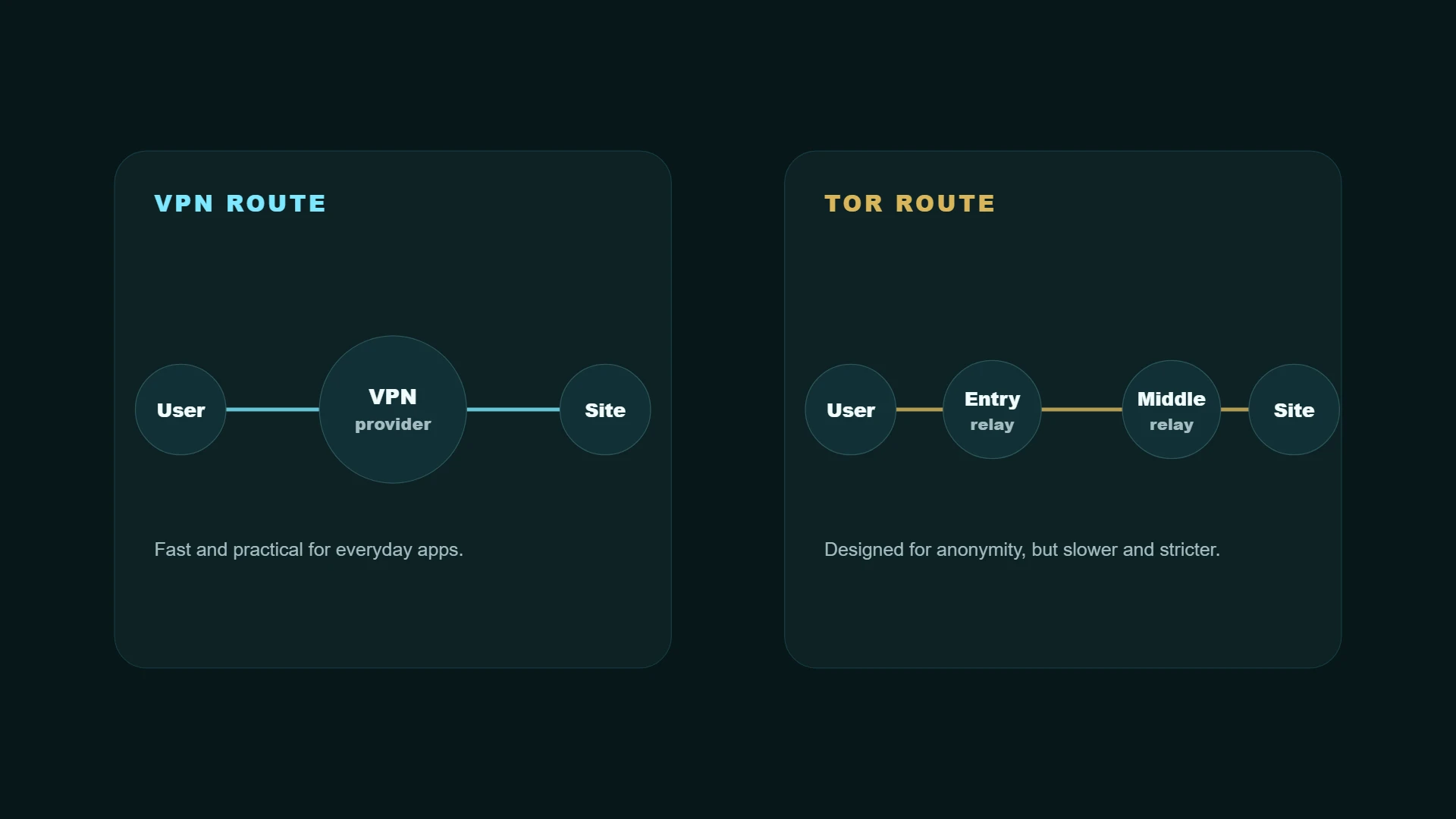
VPN vs Tor at a glance
| Question | VPN app | Tor Browser |
|---|---|---|
| What is the main job? | Route selected or device-wide traffic through an encrypted tunnel to a VPN provider. | Reduce linkability of browsing through Tor and a privacy-focused browser. |
| Which apps are covered? | Depends on the app, operating system, and exclusions. A browser extension is narrower than a device VPN. | Tor Browser traffic; other apps are not automatically protected. |
| Where does trust sit? | The provider operates the tunnel endpoint. | Trust is distributed across a circuit of relays, with important limits against powerful observers. |
| Does it reduce browser fingerprinting? | A tunnel alone does not standardize browser characteristics. | Tor Browser includes anti-fingerprinting changes; an ordinary browser routed through Tor is not equivalent. |
| Can accounts identify you? | Yes. | Yes. Logging in identifies the account to that service. |
| Is there a guaranteed speed? | No. Device, server, network, and protocol matter. | No. Relay routing and congestion can make interactive tasks less convenient. |
These coverage distinctions follow the Tor Browser design documentation, Tor’s safety guidance, and NordVPN’s distinction between apps and extensions. The choices below are Aerod’s interpretation, not a speed benchmark.
When a VPN is the better starting point
Consider a device VPN when you need an additional encrypted route on an untrusted network or want several ordinary applications to use a chosen exit region. First confirm those applications are included in the tunnel. Work-managed devices may require an employer-approved VPN instead of a consumer service.
HTTPS already protects the content of correctly secured web connections. A VPN changes the network path and who handles it; it does not replace HTTPS, fix an infected device, or prevent a website from recognizing your account. Avoid buying solely because a hotel network feels unfamiliar or an advertisement promises complete invisibility.
If a VPN fits the job, compare the VPN shortlist by use case. For two researched options, see NordVPN vs Proton VPN.
When Tor Browser is the better starting point
Consider Tor Browser when separating browsing activity from your usual identity is more important than convenience. Use the actual Tor Browser, keep it updated, and follow its defaults. The Tor Project discourages substituting another browser, because merely sending ordinary browser traffic through Tor does not reproduce its protections.
A sensitive session needs behavioral separation too: avoid personal logins and identifying form entries. Be cautious with downloaded documents opened in outside applications, which may use a different network route. Follow Tor’s current safety guidance rather than installing extra extensions or copying random “hardening” settings.
Tor is not a guarantee against an observer able to correlate traffic at multiple points, nor a substitute for individualized help in a high-risk situation. A website that accepts the connection can still observe what you submit.
Should you combine a VPN and Tor?
The Tor Project does not generally recommend combining them unless you understand how to configure both without compromising privacy. Adding another layer is not automatically an improvement.
Connecting to a VPN before opening Tor Browser adds a VPN operator and another possible failure point. Reversing the order is a different, more complex arrangement. Neither is a beginner default. If the problem is reaching Tor from a restricted network, start with Tor’s own support guidance for that situation instead of assuming a paid VPN is required.
How to verify the setup without overstating the result
- Write down the intended application coverage and whether personal accounts should be excluded from the activity.
- For a VPN, inspect split-tunneling exclusions and the exact platform’s kill-switch behavior. Proton’s documentation, for example, distinguishes accidental drops from deliberate disconnects and lists platform limitations.
- Check the visible exit using IP Lookup from the routed application. For a controlled baseline, follow how to check whether a VPN changed your IP, including IPv4, IPv6, and application coverage.
- For an ordinary VPN browser, inspect WebRTC candidates and use the Browser Permissions & Privacy Settings Check. Read how browser fingerprinting works to understand the characteristics a tunnel does not change. A test result is a snapshot, not an anonymity certificate.
- For Tor Browser, use its connection checks and official guidance. Do not modify it simply to improve a third-party test score.
FAQ
Is Tor better than a VPN?
Tor Browser is designed for anonymity-focused browsing; a VPN is usually a more practical starting point for routing ordinary device apps. The better choice depends on the observer, application coverage, and behavior you need to protect.
Is a VPN safer than Tor?
There is no universal safety winner. A VPN adds trust in an operator; Tor Browser has its own usability and anonymity limits. Neither protects a session from identifying logins, malware, or every form of traffic analysis.
Does Tor Browser protect every app on my computer?
No. Running Tor Browser does not automatically route other applications through Tor. Those applications need their own appropriate configuration.
Should I connect to a VPN before Tor?
Not by default. Tor Project guidance recommends combining them only when you understand the configuration and its privacy consequences.
Can either tool stop browser fingerprinting?
A VPN tunnel alone cannot. Tor Browser includes anti-fingerprinting protections, but neither tool promises perfect anonymity or hides information you deliberately submit.
Sources and review date
Sources checked September 2, 2026. Provider claims, original reports, and Aerod’s interpretation are distinguished above.